Electrocardiogram



ECG stands for electrocardiogram. It is also known as EKG or ECG, either to reflect the German or Dutch Elektrokardiogramm, or to avoid confusion with EEG for electroencephalogram. While there had been earlier measurements of the electric activity of the heart, the Dutch physician Willem Einthoven developed the first medically useful device in 1903, for which he received the 1924 Nobel Prize in Physiology or Medicine.
The ECG refers to the small voltages (~1mv) found on the skin as a result of electrical activity of the heart. These electrical actions trigger various electrical and muscular activity in the heart. The health and function of the heart can be measured by the shape of the ECG waveform. Typical heart problems are leaking valves and blocked coronary arteries.[1]
Performance of an ECG
ECG electrodes usually come as 3,5 or 12 lead. These are:
- 3 lead - Left ARM or LA, Right Arm or RA, and Left Leg or LL
- 5 lead - additional leads of Right Leg or RL and V for Chest
- 12 lead - additional leads of V1-V6 replacing the V lead, with each V lead being placed between the ribs[2]
The ECG paper:
- Normal speed is 25 mm/sec. At this speed
- Each 1 mm horizontal box corresponds to 0.04 second (40 ms)
- Heavier lines are placed at 0.20 sec (200 ms) intervals.
- At the normal vertical standard, 10 mm equals 1 mV.
Variations
The ECG can be combined with other cardiac tests, such as ultrasonography (i.e., echocardiography), will show the ECG actions slightly preceding muscular action.
The basic waveform

Although the appearance of the waveform should be different on the various leads, the repeating waveform has several common points of inflection or "waves", as well as some components that are present only in disease. More discussion is available online.[3]

PR interval
A prolonged PR interval is associated with increased mortality.[4]
- P wave: caused by the discharge of the sinoatrial node
QT interval
The normal duration of the QT interval is corrected for heart rate with Bazett's formula:
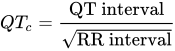
QRS complex
- The QRS complex is due to ventricular activity.
- The normal angle is -30º to + 100º.
- The normal duration is ≤0.10 sec (21/2 small boxes)
- Q: may or may not be present, and if present, may or may not indicate disease. In combination with other indications of myocardial infarction (MI), there can be useful clinical distinctions between MIs where a Q wave is present, and non-Q-wave MIs.
- R: caused by the first electrical signal arriving, via the atrioventricular node (AV node) and Purkinke fibers, at the ventricles.
- S: caused by the completion of depolarization of the ventricles after they contract
ST segment
The "segments", or sections between these above points also are clinically significant. In particular, the ST segment, which is normally isoelectric, tends to be elevated in the presence of myocardial infarction and depressed in the presence of myocardial ischemia. Even at rest, abnormal ST segments geriatric patients are a risk factor for coronary death.[5] By examining the degree of elevation or depression from the different leads, which essentially are different angles of view of the heart, it is possible to localize the damage.
- In the presence of symptoms suggestive of heart disease, myocardial infarction cannot be excluded if the ECG is normal. It is possible to have severe heart disease and a normal ECG. Other tests are needed for a conclusive diagnosis.
T wave
- T wave: repolarization of the ventricles
Common abnormalities
One of the challenges in learning to interpret electrocardiograms is that while textbooks usually show one abnormality at a time, many can coexist.
Early repolarization
Early repolarization, defined as "elevation of the junction between the end of the QRS complex and the beginning of the ST segment (J point) from baseline," when present in the inferior leads, may be a risk factor for cardiac death.[6]
A clinical prediction rule helps distinguish early repolarization from anterior ST-segment elevation myocardial infarction (STEMI):[7]
If the following value is less than or equal to 23.4, then early repolarization is diagnosed with a sensitivity of 86% and specificity of 91%.
- ([1.196 x ST-segment elevation 60 ms after the J point in lead V3 in mm]+[0.059 x QTc in ms]-[0.326 x R-wave amplitude in lead V4 in mm]
Left ventricular hypertrophy
Left ventricular hypertrophy can be assessed with the Sokolow–Lyon criteria.
ST segment elevation
ST segment depression
Q waves
Long QT interval
Partial AV block
Bigeminy and trigeminy
Prolonged PR interval
T wave inversion
Electrolyte effects on the ECG
Calcium
Hypercalcemia
- Shortening of the QT interval
Hypocalcemia
- Prolongation of the QT interval
Potassium
Hyperkalemia
- Peaked T waves; however, there is not a clear definition of peaking and even cardiologists have difficulty agreeing when peaking is present.[8] However, if the T-wave amplitude in lead with maximum R-wave deflection is over 5 or 10 mm, this correlates with expert assessment of peaking.
- PR interval lengthens
- QRS duration increases
Hypokalemia
- Depression of the ST segment
- Decrease in the amplitude of the T wave
- U waves, especially in the lateral precordial leads V4-V6
Magnesium
References
- ↑ Noble RJ, Hillis JS, Rothbaum DA (1990). “Electrocardiography”, Walker HK, Hall WD, Hurst JW: Clinical methods: the history, physical, and laboratory examinations (in English), 3rd. London: Butterworths, 164. LCC RC71 .C63. ISBN 0-409-90077-X. Library of Congress
- ↑ Dale Dubin, Rapid Interpretation of EKG's (Third ed.), C.O.V.E.R, pp. 21-38
- ↑ Noble RJ, Hillis JS, Rothbaum DA (1990). “Electrocardiography”, Walker HK, Hall WD, Hurst JW: Clinical methods: the history, physical, and laboratory examinations (in English), 3rd. London: Butterworths, 164. LCC RC71 .C63. ISBN 0-409-90077-X. Library of Congress PDF
- ↑ Cheng S, Keyes MJ, Larson MG, et al. (June 2009). "Long-term outcomes in individuals with prolonged PR interval or first-degree atrioventricular block". JAMA 301 (24): 2571–7. DOI:10.1001/jama.2009.888. PMID 19549974. Research Blogging.
- ↑ Kumar A, Prineas RJ, Arnold AM, et al (December 2008). "Prevalence, prognosis, and implications of isolated minor nonspecific ST-segment and T-wave abnormalities in older adults: cardiovascular health study". Circulation 118 (25): 2790–6. DOI:10.1161/CIRCULATIONAHA.108.772541. PMID 19064684. Research Blogging.
- ↑ Tikkanen JT, Anttonen O, Junttila MJ, Aro AL, Kerola T, Rissanen HA et al. (2009). "Long-Term Outcome Associated with Early Repolarization on Electrocardiography.". N Engl J Med. DOI:10.1056/NEJMoa0907589. PMID 19917913. Research Blogging.
- ↑ Smith SW, Khalil A, Henry TD, Rosas M, Chang RJ, Heller K et al. (2012). "Electrocardiographic Differentiation of Early Repolarization From Subtle Anterior ST-Segment Elevation Myocardial Infarction.". Ann Emerg Med. DOI:10.1016/j.annemergmed.2012.02.015. PMID 22520989. Research Blogging.
- ↑ Montague BT, Ouellette JR, Buller GK (2008). "Retrospective review of the frequency of ECG changes in hyperkalemia.". Clin J Am Soc Nephrol 3 (2): 324-30. DOI:10.2215/CJN.04611007. PMID 18235147. PMC PMC2390954. Research Blogging.