Affine scheme



Definition
For a commutative ring , the set (called the prime spectrum of ) denotes the set of prime ideals of A. This set is endowed with a topology of closed sets, where closed subsets are defined to be of the form



for any subset . This topology of closed sets is called the Zariski topology on . It is easy to check that , where is the ideal of generated by .




The functor V and the Zariski topology
The Zariski topology on satisfies some properties: it is quasi-compact and , but is rarely Hausdorff. is not, in general, a Noetherian topological space (in fact, it is a Noetherian topological space if and only if is a Noetherian ring.

The Structural Sheaf
has a natural sheaf of rings, denoted by and called the structural sheaf of X. The pair is called an affine scheme. The important properties of this sheaf are that
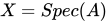


- The stalk is isomorphic to the local ring , where is the prime ideal corresponding to .
- For all , , where is the localization of by the multiplicative set . In particular, .






Explicitly, the structural sheaf may be constructed as follows. To each open set , associate the set of functions



; that is, is locally constant if for every , there is an open neighborhood contained in and elements such that for all , (in particular, is required to not be an element of any ). This description is phrased in a common way of thinking of sheaves, and in fact captures their local nature. One construction of the sheafification functor makes use of such a perspective.




The Category of Affine Schemes
Regarding as a contravariant functor between the category of commutative rings and the category of affine schemes, one can show that it is in fact an anti-equivalence of categories.

==Curves==