Category of functors
Jump to navigation
Jump to search




This article focuses on the category of contravariant functors between two categories.
The category of functors
Let and be two categories. The category of functors has



- Objects are functors
- A morphism of functors is a natural transformation ; i.e., for each object of , a morphism in such that for all morphisms in , the diagram (DIAGRAM) commutes.






A natural isomorphism is a natural transformation such that is an isomorphism in for every object . One can verify that natural isomorphisms are indeed isomorphisms in the category of functors.


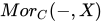
An important class of functors are the representable functors; i.e., functors that are naturally isomorphic to a functor of the form .

Examples
- In the theory of schemes, the presheaves are often referred to as the functor of points of the scheme X. Yoneda's lemma allows one to think of a scheme as a functor in some sense, which becomes a powerful interpretation; indeed, meaningful geometric concepts manifest themselves naturally in this language, including (for example) functorial characterizations of smooth morphisms of schemes.

The Yoneda lemma
Let be a category and let be objects of . Then

- If is any contravariant functor , then the natural transformations of to are in correspondence with the elements of the set .
- If the functors and are isomorphic, then and are isomorphic in . More generally, the functor , , is an equivalence of categories between and the full subcategory of representable functors in .