Total derivative

From Citizendium, the Citizens' Compendium

Jump to: navigation, search


This article is a stub and thus not approved.
Main Article
Talk
Related Articles  [?]
Bibliography  [?]
External Links  [?]
 
This is a draft article, under development and not meant to be cited but you can help to improve it. These unapproved articles are subject to a disclaimer.

In mathematics, a total derivative of a function of several variables is its derivative with respect to one of those variables, but taking into account eventual indirect dependencies, i.e. the fact that the other variables may depend on this variable. This is in contrast with the partial derivative at which other variables are thought constant.

For example, the total derivative of the function f(x,y,z) with respect to the variable x is
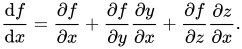
 \frac{\mathrm df}{\mathrm dx}=\frac{\partial f}{\partial x} + \frac{\partial f}{\partial y} \frac{\partial y}{\partial x} + \frac{\partial f}{\partial z} \frac{\partial z}{\partial x}.


See also

Views
Personal tools

