Lorentz-Lorenz relation



In physics, the Lorentz-Lorenz relation is an equation between the index of refraction n and the density ρ of a dielectric (non-conducting matter),
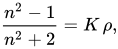
where the proportionality constant K depends on the polarizability of the molecules constituting the dielectric.
The relation is named after the Dutch physicist Hendrik Antoon Lorentz and the Danish physicist Ludvig Valentin Lorenz.
For a molecular dielectric consisting of a single kind of non-polar molecules, the proportionality factor K (m3/kg) is,
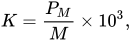
where M (g/mol) is the the molar mass (formerly known as molecular weight) and PM (m3/mol) is (in SI units):
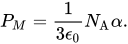
Here NA is Avogadro's constant, α is the molecular polarizability of one molecule, and ε0 is the electric constant (permittivity of the vacuum). In this expression for PM it is assumed that the molecular polarizabilities are additive; if this is not the case, the expression can still be used when α is replaced by an effective polarizability. The factor 1/3 arises from the assumption that a single molecule inside the dielectric feels a spherical field from the surrounding medium. Note that α / ε0 has dimension volume, so that K indeed has dimension volume per mass.
In Gaussian units (a non-rationalized centimeter-gram-second system):
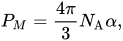
and the factor 103 is absent from K (as is ε0, which is not defined in Gaussian units).
For polar molecules a temperature dependent contribution due to the alignment of dipoles must be added to K.
The Lorentz-Lorenz law follows from the Clausius-Mossotti relation by using that the index of refraction n is approximately (for non-conducting materials and long wavelengths) equal to the square root of the static relative permittivity (formerly known as static relative dielectric constant) εr,

In this relation it is presupposed that the relative permeability μr equals unity, which is a reasonable assumption for diamagnetic and paramagnetic matter, but not for ferromagnetic materials.
References
- H. A. Lorentz, Über die Beziehung zwischen der Fortpflanzungsgeschwindigkeit des Lichtes und der Körperdichte [On the relation between the propagation speed of light and density of a body], Ann. Phys. vol. 9, pp. 641-665 (1880). Online
- L. Lorenz, Über die Refractionsconstante [About the constant of refraction], Ann. Phys. vol. 11, pp. 70-103 (1880). Online