Wavenumber



In science, the wavenumber indicates the number of wavelengths that would fit in a unit of length, and is numerically equal to the reciprocal or inverse of the wavelength. The normal units for wavenumbers are inverse centimeters cm-1. A different name for this unit is kayser (after Heinrich Kayser). Light with a wavelength of 500 nm (green) has a wavenumber of 20,000 cm-1 or 20 kK. Photon energy and frequency are proportional to wavenumber: 10 kK corresponds to 1.24 eV.
Historically, wavenumbers were introduced by Janne Rydberg in the 1880's in his analyses of atomic spectra.
The wavevector(), wavelength (), and frequency () are related:


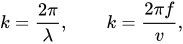
where is the speed of the wave.

Sometimes () is also referred to as wavenumber, but is greater by a factor of than the wavenumber described earlier as the reciprocal () of the wavelength. One way to keep the distinction clear is to think of the wavenumber as the number of wave cycles per unit distance, and the wavevector as the number of radians per unit distance, where as always there are radians in one cycle. As radians and cycles are both considered dimensionless quantities, both wavenumber and wavevector are given in the same units of inverse length.

