Radian
Jump to navigation
Jump to search




In mathematics, a radian is the angle subtended by an arc length equal to the radius of a circle. There are 2π radians in a full circle, as the arc length of the circumference of a circle is equal to 2π times the radius of the circle.
The radian is considered a dimensionless derived unit in the International System of Units.
Measuring angles in radians often allows the direct use of angles in mathematical formulae, particularly in trigonometric functions and their expansions.
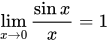
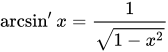
Generally, identities arising in calculus and involving trigonometric functions are true only when the variables that are arguments to trigonometric functions are expressed in radians. Among those are the following:

Other units
- 1 radian is equal to or 57.295 779 513... degrees of arc
- 1 radian is equal to or 63.661 977 237... grads

