Kronecker delta



In algebra, the Kronecker delta is a notation for a quantity depending on two subscripts i and j which is equal to one when i and j are equal and zero when they are unequal:


If the subscripts are taken to vary from 1 to n then δ gives the entries of the n-by-n identity matrix. The invariance of this matrix under orthogonal change of coordinate makes δ a rank two tensor.
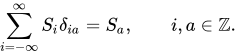
Kronecker deltas appear frequently in summations where they act as a "filter". To clarify this we consider a simple example

that is, the element S4 is "sifted out" of the summation by δi,4.
In general, (i and a integers)
The Kronecker delta is named after the German mathematician Leopold Kronecker (1823 – 1891). See Dirac delta function for a generalization of the Kronecker delta to real i and j.