A geometric series is a series associated with a geometric sequence,
i.e., the ratio (or quotient) q of two consecutive terms is the same for each pair.
Thus, every geometric series has the form

where the quotient (ratio) of the (n+1)th and the nth term is

The sum of the first n terms of a geometric sequence is called the n-th partial sum (of the series); its formula is given below (Sn).
An infinite geometric series (i.e., a series with an infinite number of terms) converges if and only if |q|<1, in which case its sum is  , where a is the first term of the series.
In finance, since compound interest generates a geometric sequence,
regular payments together with compound interest lead to a geometric series.
Remark
Since every finite geometric sequence is the initial segment of a uniquely determined infinite geometric sequence every finite geometric series is the initial segment of a corresponding infinite geometric series. Therefore, while in elementary mathematics the difference between "finite" and "infinite" may be stressed, in more advanced mathematical texts "geometrical series" usually refers to the infinite series.
Examples
| Positive ratio
|
|
Negative ratio
|
The series

and corresponding sequence of partial sums
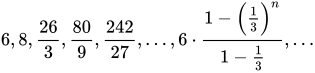
is a geometric series with quotient

and first term

and therefore its sum is

|
|
The series

and corresponding sequence of partial sums
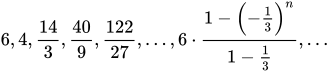
is a geometric series with quotient

and first term
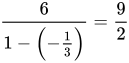
and therefore its sum is
|
The sum of the first 5 terms — the partial sum S5 (see the formula derived below) —
is for q = 1/3
![{\displaystyle S_{5}=6+2+{\frac {2}{3}}+{\frac {2}{9}}+{\frac {2}{27}}=6\left[1+{\frac {1}{3}}+{\Big (}{\frac {1}{3}}{\Big )}^{2}+{\Big (}{\frac {1}{3}}{\Big )}^{3}+{\Big (}{\frac {1}{3}}{\Big )}^{4}\right]=6\left[{\frac {1-({\frac {1}{3}})^{5}}{1-{\frac {1}{3}}}}\right]={\frac {242}{27}}}](https://wikimedia.org/api/rest_v1/media/math/render/svg/efcd7c3270ebd2e60059553c47c5a050153bf744)
and for q = −1/3
![{\displaystyle S_{5}=6-2+{\frac {2}{3}}-{\frac {2}{9}}+{\frac {2}{27}}=6\left[1-{\frac {1}{3}}+{\Big (}{\frac {1}{3}}{\Big )}^{2}-{\Big (}{\frac {1}{3}}{\Big )}^{3}+{\Big (}{\frac {1}{3}}{\Big )}^{4}\right]=6\left[{\frac {1+({\frac {1}{3}})^{5}}{1+{\frac {1}{3}}}}\right]={\frac {122}{27}}}](https://wikimedia.org/api/rest_v1/media/math/render/svg/fa851d6fabdc83507983e80d46ced6d30ede4609)
Application in finance
When regular payments are combined with compound interest this generates a geometric series:
Regular deposits
If, for n time periods, a sum P is deposited at an interest rate of p percent,
then — after the n-th period —
the first payment has increased to
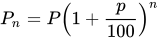
the second to
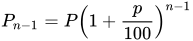
etc., and the last one to
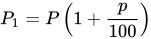
Thus the cumulated sum

is the n-th partial sum of a geometric series.
Regular down payments
If a loan L is to be payed off by n regular payments P,
the total payment nP has to cover both the loan L and the accumulated interest I.
The interest for the payment at the end of the first time period is
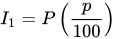 ,
,
for the payment after two time periods it is
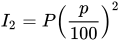 ,
,
etc., and for the last payment after n time periods the interest is
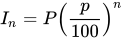 .
.
Thus the accumulated interest

is the n-th partial sum of a geometric series.
(From this equation, P can easily be calculated.)
Mathematical treatment
By definition, a geometric series
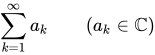
can be written as

where

Partial sums
The partial sums of the series Σqk are

because

Thus

Limit
Since

it is

Thus the sum or limit of the series is
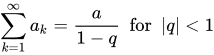
Geometric power series
For each q, the geometric series is a series of numbers, but
since — apart from the constant factor a — they all have the same form Σqk,
it is convenient to replace the quotient q by a variable x and consider the (real or complex) geometric power series
(a series of functions):
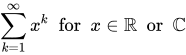
The convergence radius of this power series is 1. It
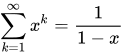
- converges (more precisely: converges absolutely) for |x|<1 with the sum
- and diverges for |x| ≥ 1.
-
- For x ≥ 1 the limit is +∞.
- For x = −1 the series alternates between 1 and 0.
- For x < −1 the sign of partial sums alternates, the limit of their absolute values is ∞, but no infinite limit exists.
- For |x| = 1 and x ≠ 1 (i.e., x = −1 or non-real complex) the partial sums Sn are bounded but not convergent.
- For |x| > 1 and x non-real complex the partial sums oscillate, the limit of their absolute values is ∞, but no infinite limit exists.
A notation: q-analogues
In combinatorics, the partial sums of the geometric series are essential for
the definition of q-analogs, and the following shorthand notation
![{\displaystyle [n]_{q}=1+q+q^{2}+q^{3}+\cdots +q^{n-1}}](https://wikimedia.org/api/rest_v1/media/math/render/svg/b13d491c876da794f55572a5f93c3611da706fc8)
is used for the q-analogue of a natural number n.



