Exponent



An exponent is a mathematical notation used to represent the operation of exponentiation. It is usually written as a superscript on a number or variable, called the base. For example, in the expression , the base is 5 and the exponent is 4.

Exponents are often numbers or variables. The original usage for exponents is using a numerical base with a positive whole number exponent to represent the quantity obtained by multiplying the base by itself times. For example, the expression is defined to be 5 multiplied by itself 4 times: .


Through centuries of development, the use of exponents has been extended to allow many other types of exponents, including negative integers, rational numbers, real numbers, complex numbers, and even matrices, sets, and other more complicated types of mathematical objects. These more exotic types of exponents no longer have meanings as simple as the product of a base with itself a certain number of times. Furthermore, in these more general contexts, not all exponential expressions have meaning (for instance, is considered undefined). The large variety of meanings for exponential expressions and restrictions on when they have meaning at all often presents a strong barrier to mathematics students. Fortunately, the rules for exponentiation keep the same form and remain true regardless of the types of exponent being considered.

Exponents in complex expressions
Expressions involving exponentiation as well as other operations can appear ambiguous. For instance, consider the following two proposed ways of evaluating the same expression:


In the given expression , there are two different operations appearing, addition and exponentiation. In example 1 above, the 2 was raised to the 3rd power first, and then 5 was added to the result second. In the second example, the 5 and 2 were added first, and then the result was raised to the 3rd power second. Observe that just by changing the order in which the operations were done, we obtained drastically different results.

Mathematical writing is used primarily to communicate information to other people. Because of this, mathematical notation must be extremely precise so that all people who read mathematical notation will understand it to mean the same thing. For evaluating expressions with multiple operations, the precise order that the operations must be evaluated is known as the order of operations, and is a worldwide standard. For expressions involving parentheses, exponents, and the four arithmetic operations , expressions inside parentheses are to be evaluated before those outside, and exponentiation is to be performed before the other four operations. Furthermore, if an exponent is a complicated expression, it must be evaluated before the exponentiation is performed (see rule 1 for exponents in the following section for an example).

For instance, example 1 above is the correct procedure, even though the first operation to be evaluated is the one that appears second as you read left to right. If we instead wanted to add 5 and 2 and then raised to the 3rd power, as in example 2, we would need to insert parentheses:
- .

It is imperative to observe here that we would not obtain the same answer by trying to "distribute" the exponent here. Exponents cannot generally be distributed across sums the same way multiplication can, even though exponents are initially defined by successive multiplication. If we try to distribute, we find

We see that the rules for using exponential notation differ significantly from those for multiplicative notation, so great care must be exerted to ensure that one knows the rules for each operation precisely, both those that work and those that generally do not.
Rules for exponents
There are two rules for exponents that always apply, regardless of what types of quantities the base and exponent are. They are:
- , and


Distinguishing between these statements and understanding what they mean can often pose a barrier to mathematics students. The difficulty usually arises from trouble understanding the order of operations for evaluating each side above. Let us clarify through and example. Set , , and in the first rule above. The left side evaluates to


- ,

where we observe that the complicated exponent must be simplified to before the exponentiation is performed (as dictated by order of operations). On the other hand, the right side of the first rule above evaluates to


- .

Each of these expressions evaluated to the same number, 16, as the first rule says should happen.
Observe that this rule is a little strange --- the addition in the exponent on the left side becomes multiplication on the right side. Typically, , as you might expect if you are looking for more symmetry in the formula or are hoping that a base can be "distributed" across a sum.

This poses a difficulty because there are times when you might be presented with and need to know that it equals , and other times that you might be presented with and need to know that it equals . Because exponents and multiplication appear in both and , it is possible to confuse rules 1 and 2. The way to keep this straight is not to remember the rules in the form "if an exponent and a product appear, then you can convert it to an exponent and a sum". This has two problems. First, it is not precise since exponents and products can appear in different configurations with different meanings. Second, it lacks any understanding of what exponents and products actually represent (i.e., what calculations are being performed), and what the difference is. A better procedure is to spend the time to memorize both formulas precisely by rote, and to be able to see why the formulas hold by giving an example with numbers in place of .


Extension of exponents to fractional and negative values
Originally, exponents were natural numbers: it's easy to see the meaning of an expression such as . The above rules for adding and multiplying exponents were noticed, and to extend the idea to fractions and negative numbers it was assumed that the same rules would apply. To define a meaning for a fractional value such as , consider that, using a rule for multiplying exponents,



Therefore must be . Values for many other numbers can be worked out similarly using cube roots and so on, and values for all real numbers can then be defined using limits.

To assign meaning to negative values of exponents, note the rule that

So, for example, to find the meaning of consider


Therefore,
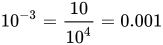
By a similar argument it can be established that for any base .

