Euler pseudoprime
Jump to navigation
Jump to search




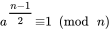
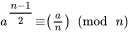
A composite number n is called an Euler pseudoprime to a natural base a if or

Properties
- Every Euler pseudoprime is odd.
- Every Euler pseudoprime is also a Fermat pseudoprime:
- and
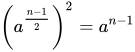
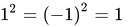
- Every Euler Pseudoprime to base a that satisfies is an Euler-Jacobi pseudoprime.
- Strong pseudoprimes are Euler pseudoprimes too.
Absolute Euler pseudoprime
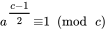
An absolute Euler pseudoprime is a composite number c that satisfies the congruence or for every base a that is coprime to c. Every absolute Euler pseudoprime is also a Carmichael number.
Further reading
- Richard E. Crandall and Carl Pomerance. Prime Numbers: A Computational Perspective. Springer-Verlag, 2001, ISBN 0-387-25282-7
- Paulo Ribenboim. The New Book of Prime Number Records. Springer-Verlag, 1996, ISBN 0-387-94457-5