Discriminant of an algebraic number field



In algebraic number theory, the discriminant of an algebraic number field is an invariant attached to an extension of algebraic number fields which describes the geometric structure of the ring of integers and also encodes ramification data.
The relative discriminant ΔK/L is attached to an extension K over L; the absolute discriminant of K refers to the case when L = Q.
Absolute discriminant
Let K be a number field of degree n over Q. Let OK denote the ring of integers or maximal order of K. As a free Z-module it has a rank n; take a Z-basis . The discriminant


Since any two Z-bases are related by a unimodular change of basis, the discriminant is independent of the choice of basis.
An alternative definition makes use of the n different embeddings of K into the field of complex numbers C, say σ1, ...,σn:

We see that these definitions are equivalent by observing that if
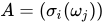
then

and then taking determinants.