Derivative at a point



The derivative at a point is a fundamental mathematical notion of calculus and analysis. Informally, it shows the rate of change exhibited by a function at a particular point.
Probably the best known example of the derivative is velocity: While the mean velocity is obtained by dividing the distance travelled by the time needed, the velocity at a particular moment — as shown by a speedometer — is the differential quotient of the distance travelled (as function of the time needed) at that moment, i.e., for practical purposes, the mean velocity in a very short time interval or, in mathematical terms, the limit to that these mean velocities converge.
The derivative at a point does not always exist. If, for some function, the derivative exists at all (or "almost all") points then the resulting function is called the derivative of the function.
Remark:
The derivative at a point is a value defined locally to the point considered,
while the derivative (of a function) is a global function whose values coincide with the values obtained by the derivatives at points.
This subtle difference is easier to expressed using a term that is only rarely used in English, the differential quotient:
The differential quotient (the limit of the difference quotients) is the locally defined value (the derivative at the point) that
coincides with the value of the globally defined derivative at that point.
Definition
The derivative of a real or complex function at a point is a measure of how rapidly the function changes locally (near this point) when its argument changes.
In order to define the derivative, a difference quotient is constructed.
The derivative of the function f at a is defined as the limit

as x approaches x0 or, equivalently, h approaches zero, if this limit exists. The quotients of which the limit is taken are called difference quotients.
If the limit exists, then f is said to be differentiable at a. If a function is differentiable in all the points in which it is defined, then it is said to be differentiable.
If a function is differentiable in a point, then it is also continuous in that point. The reverse is not true as the following example shows:
- The absolute value f(x) = |x| is continuous in the point 0, but not differentiable at 0:
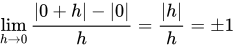
- (We see that this expression has the limit 1 when we approach zero from the right side, but the limit −1 when we approach from the left side. Hence, the function is not differentiable.)
Some notational styles
These are all equivalent ways to denote the derivative of a function f in the point x.



Multivariable calculus
The extension of the concept of derivative to multivariable functions, or vector-valued functions of vector variables, may be achieved by considering the derivative as a linear approximation to a differentiable function. In the one variable case we can regard as a linear function of one variable which is a close approximation to the function at the point .



Let be a function of n variables. We say that F is differentiable at a point if there is a linear function such that




where denotes the Euclidean distance in .


The derivative , if it exists, is a linear map and hence may be represented by a matrix. The entries in the matrix are the partial derivatives of the component functions of Fj with respect to the coordinates xi. If F is differentiable at a point then the partial derivatives all exist at that point, but the converse does not hold in general.

Formal derivative
The derivative of the monomial Xn may be formally defined as and this extends to a linear map D on the polynomial ring over any ring R. Similarly we may define D on the ring of formal power series .

![{\displaystyle R[X]}](https://wikimedia.org/api/rest_v1/media/math/render/svg/afeccd52deabb878398a8485755c3ceea80caf9a)
![{\displaystyle R[[X]]}](https://wikimedia.org/api/rest_v1/media/math/render/svg/fc00b68cd3f2c0346dea47d276cea5331fa55159)
The map D is a derivation, that is, an R-linear map such that
