Dedekind domain
Jump to navigation
Jump to search




A Dedekind domain is a Noetherian domain , integrally closed in its field of fractions, so that every prime ideal is maximal.

These axioms are sufficient for ensuring that every ideal of that is not or can be written as a finite product of prime ideals in a unique way (up to a permutation of the terms of the product). In fact, this property has a natural extension to the fractional ideals of the field of fractions of .


This product extends to the set of fractional ideals of the field (i.e., the nonzero finitely generated -submodules of ).
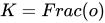

Useful properties
- Every principal ideal domain is a unique factorization domain, but the converse is not true in general. However, these notions are equivalent for Dedekind domains; that is, a Dedekind domain is a principal ideal domain if and only if it is a unique factorization domain.
- The localization of a Dedekind domain at a non-zero prime ideal is a principal ideal domain, which is either a field or a discrete valuation ring.

Examples
- The ring is a Dedekind domain.
- Let be an algebraic number field. Then the integral closure of in is again a Dedekind domain. In fact, if is a Dedekind domain with field of fractions , and is a finite extension of and is the integral closure of in , then is again a Dedekind domain.


==Finitely generated modules over a Dedekind domain==