Continuity



In mathematics, the notion of continuity of a function relates to the idea that the "value" of the function should not jump abruptly for any vanishingly "small" variation to its argument. Another way to think about a continuity of a function is that any "small" change in the argument of the function can only effect a correspondingly "small" change in the value of the function.
Formal definitions of continuity
We can develop the definition of continuity from the formalism which are usually taught in first year calculus courses to general topological spaces.

Function of a real variable
The formalism defines limits and continuity for functions which map the set of real numbers to itself. To compare, we recall that at this level a function is said to be continuous at if (it is defined in a neighborhood of and) for any there exist such that



Simply stated, the limit
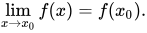
This definition of continuity extends directly to functions of a complex variable.
Function on a metric space
A function f from a metric space to another metric space is continuous at a point if for all there exists such that



If we let denote the open ball of radius r round x in X, and similarly denote the open ball of radius r round y in Y, we can express this condition in terms of the pull-back


![{\displaystyle f^{\dashv }[B_{e}(f(x),\varepsilon )]\supseteq B_{d}(x,\delta ).\,}](https://wikimedia.org/api/rest_v1/media/math/render/svg/32230d8324aa7a05601e173c0e92dca654b7d773)
Function on a topological space
A function f from a topological space to another topological space , usually written as , is said to be continuous at the point if for every open set containing the point y=f(x), there exists an open set containing x such that . Here . In a variation of this definition, instead of being open sets, and can be taken to be, respectively, a neighbourhood of x and a neighbourhood of .





Continuous function
If the function f is continuous at every point then it is said to be a continuous function. There is another important equivalent definition that does not deal with individual points but uses a 'global' approach. It may be convenient for topological considerations, but perhaps less so in classical analysis. A function is said to be continuous if for any open set (respectively, closed subset of Y ) the set is an open set in (respectively, a closed subset of X).


