Compton scattering
(Redirected from Compton Scattering)
Jump to navigation
Jump to search



Compton Scattering is a phenomenon in physics, first explained by Arthur Holly Compton, that confirms the quantum nature of x-rays. If a stream of x-rays is fired at a target the rays will be scattered and the scattered radiation will have smaller frequency (and longer wavelength) than the incident radiation. The change in wavelength is dependant on the angle through which the radiation is scattered. Arthur Compton earned the 1927 Nobel Prize for Physics for his discovery.
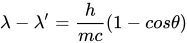
Compton Scattering Formula
For radiation of wavelength λ that is incident on a target consisting of charged particles of mass m and scattered at an angle θ from its incident direction, the wavelength λ' of the scattered radiation can be determined from: