Compact space



In mathematics, a compact space is a topological space for which every covering of that space by a collection of open sets has a finite subcovering. If the space is a metric space then compactness is equivalent to the set being complete and totally bounded and again equivalent to sequential compactness: that every sequence in the set has a convergent subsequence.
A subset of a topological space is compact if it is compact with respect to the subspace topology. A compact subset of a Hausdorff space is closed, but the converse does not hold in general. For the special case that the set is a subset of a finite dimensional normed space, such as the Euclidean spaces, then compactness is equivalent to that set being closed and bounded: this is the Heine-Borel theorem.
Cover and subcover of a set
Let A be a subset of a set X. A cover for A is any collection of subsets of X whose union contains A. In other words, a cover is of the form

where is an arbitrary index set, and satisfies


An open cover is a cover in which all of the sets are open. Finally, a subcover of is a subset of the form



with such that


Formal definition of compact space
A topological space X is said to be compact if every open cover of X has a finite subcover, that is, a subcover which contains at most a finite number of subsets of X (in other words, the index set is finite).

Finite intersection property
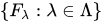
Just as the topology on a topological space may be defined in terms of the closed sets rather than the open sets, so we may transpose the definition of compactness in terms of open sets into a definition in terms of closed sets. A space is compact if the closed sets have the finite intersection property: if is a family of closed sets with empty intersection, , then a finite subfamily has empty intersection .



Examples
- Any finite space.
- An indiscrete space.
- A space with the cofinite topology.
- The Heine-Borel theorem: In Euclidean space with the usual topology, a subset is compact if and only if it is closed and bounded.
Properties
- Compactness is a topological invariant: that is, a topological space homeomorphic to a compact space is again compact.
- A closed set in a compact space is again compact.
- A subset of a Hausdorff space which is compact (with the subspace topology) is closed.
- The quotient topology on an image of a compact space is compact
- The image of a compact space under a continuous map to a Hausdorff space is compact.
- The Cartesian product of two (and hence finitely many) compact spaces with the product topology is compact.
- The Tychonoff product theorem: The product of any family of compact spaces with the product topology is compact. This is equivalent to the Axiom of Choice.
- If a space is both compact and Hausdorff then no finer topology on the space is compact, and no coarser topology is Hausdorff.