In mathematics, the Cauchy-Schwarz inequality is a fundamental and ubiquitously used inequality that relates the absolute value of the inner product of two elements of an inner product space with the magnitude of the two said vectors. It is named in the honor of the French mathematician Augustin-Louis Cauchy and German mathematician Hermann Amandus Schwarz[1].
The inequality for real numbers
The simplest form of the inequality, and the first one considered historically, states that

for all real numbers x1, …, xn, y1, …, yn (where n is a arbitrary positive integer). Furthermore, the inequality is in fact an equality

if and only if there is a number C such that  for all i.
The inequality for inner product spaces
Let V be a complex inner product space with inner product  . Then for any two elements
  it holds that

where 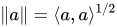 for all
  . Furthermore, the equality in (1) holds if and only if the vectors
  and
and  are linearly dependent (in this case proportional one to the other).
If V is the Euclidean space Rn, whose inner product is defined by
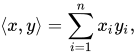
then (1) yields the inequality for real numbers mentioned in the previous section.
Another important example is where V is the space L2([a, b]). In this case, the Cauchy-Schwarz inequality states that

for all real functions f and g in ![{\displaystyle \scriptstyle L^{2}([a,b])}](https://wikimedia.org/api/rest_v1/media/math/render/svg/f571115419d48c245347809d178ba4d47b139060) .
.
Proof of the inequality
A standard yet clever idea for a proof of the Cauchy-Schwarz inequality for inner product spaces is to exploit the fact that the inner product induces a quadratic form on V. Let  be some fixed pair of vectors in V and let
  be the argument of the complex number
  . Now, consider the expression
  for any real number t and notice that, by the properties of a complex inner product, f is a quadratic function of t. Moreover, f is non-negative definite:
  for all t. Expanding the expression for f gives the following:

Since f is a non-negative definite quadratic function of t, it follows that the discriminant of f is non-positive definite. That is,

from which (1) follows immediately.
References
- ↑ Biography at MacTutor History of Mathematics, John J. O'Connor and Edmund F. Robertson, School of Mathematics and Statistics, University of St Andrews, Scotland.



