Caratheodory extension theorem



In the branch of mathematics known as measure theory, the Caratheodory extension theorem states that a countably additive non-negative set function on an algebra of subsets of a set can be extended to be a measure on the sigma algebra generated by that algebra. Measure in this context specifically refers to a non-negative measure.
Statement of the theorem
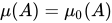
(Caratheodory extension theorem) Let X be a set and be an algebra of subsets of X. Let be a countably additive non-negative set function on . Then there exists a measure on the -algebra (i.e., the smallest sigma algebra containing ) such that for all . Furthermore, if then the extension is unique.




is also referred to as the sigma algebra generated by . The term "algebra of subsets" in the theorem refers to a collection of subsets of a set X which contains X itself and is closed under the operation of taking complements, finite unions and finite intersections in X. That is, any algebra of subsets of X satisfies the following requirements:


- If then
- For any positive integer n, if then




The last two properties imply that is also closed under the operation of taking finite intersections of elements of .
References
- D. Williams, Probability with Martingales, Cambridge : Cambridge University Press, 1991.