In elementary algebra, the binomial theorem or the binomial expansion is a mechanism by which expressions of the form  can be expanded. It is the identity that states that for any non-negative integer n,
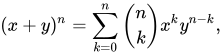
where
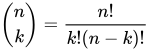
is a binomial coefficient. Another useful way of stating it is the following:

Pascal's triangle
An alternate way to find the binomial coefficients is by using Pascal's triange. The triangle is built from apex down, starting with the number one alone on a row. Each number is equal to the sum of the two numbers directly above it.
n=0         1
n=1        1 1
n=2       1 2 1
n=3      1 3 3 1
n=4     1 4 6 4 1
n=5   1 5 10 10 5 1
Thus, the binomial coefficients for the expression  are 1, 3, 6, 4, and 1.
Proof
One way to prove this identity is by mathematical induction.
Base case: n = 0
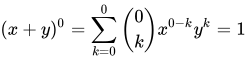
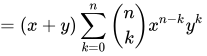
Induction case: Now suppose that it is true for n : 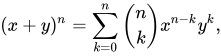 and prove it for n + 1.





![{\displaystyle =\sum _{k=0}^{n+1}\left[{n \choose k}+{n \choose {k-1}}\right]x^{n+1-k}y^{k}\,}](https://wikimedia.org/api/rest_v1/media/math/render/svg/c1f147a519a0c6ba20e962b554bbfb0268d8424b)
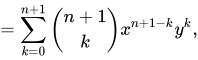
and the proof is complete.
Examples
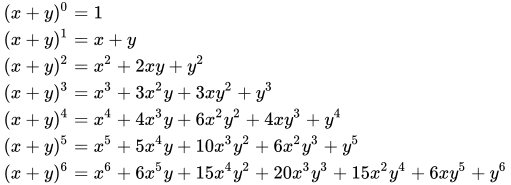
These are the expansions from 0 to 6.
Newton's binomial theorem
There is also Newton's binomial theorem, proved by Isaac Newton, that goes beyond elementary algebra into mathematical analysis, which expands the same sum (x + y)n as an infinite series when n is not an integer or is not positive.



